

She drove three hours to help her mother with paperwork that needed to be notarized. It was the first visit since a stretch of heavy winter storms, and the to-do list was the usual mix of household chores and important administrative tasks that are just easier to handle in person.
Before she even got inside, she noticed something wrong.
A neighbor’s gutter downspout extender had been buried by storm runoff and was now draining directly toward her mother’s foundation. She could see the water intrusion in the basement walls. So she did what any good daughter would do: she went outside and started digging.
That is when she heard the buzzing.
She looked up and saw a dense mass of bees clustered at the edge of the roofline. She pulled out her phone and sent me a text with a photo: Do you know what this is?
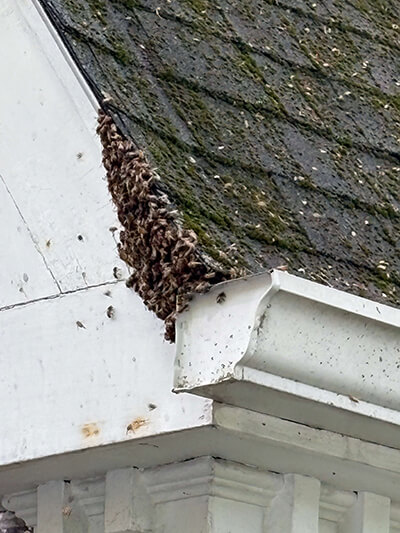
A Swarm in Progress
As it happens, I have beekeepers in my family, so I recognized it immediately. That was a swarm. A colony that has outgrown its hive sends the queen and a large group of workers out to find a new home. They travel together, cluster somewhere temporarily, and scout the area. If they like what they find, they move in.
And what they had found was an opening in the roofline of her mother’s house.
We did some quick research together and got her the names of local beekeeping organizations and individuals who handle swarm removal.
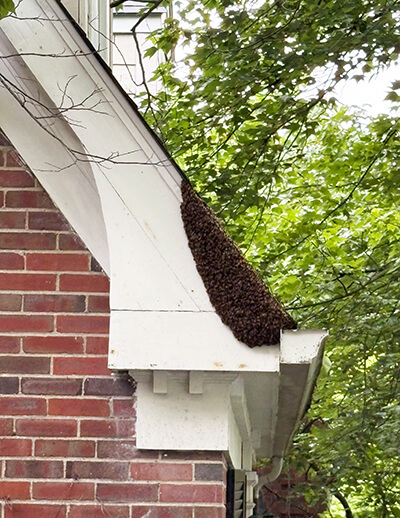
Within a couple of hours, she sent another photo. What had started as a loose cluster was now a solid, settled mass. The bees were not just visiting. They were moving in.
A few hours after that, a beekeeper arrived and carefully removed the swarm, relocating it safely to a proper hive. Then he did something equally important: he found the gap in the roofline and sealed it, so no future scouts could identify it as a vacancy.
What Would Have Happened Otherwise
If she had not been outside that day, digging out a drainage pipe, she would never have looked up. The swarm would have moved in quietly. By the time anyone noticed, there would have been a full colony established in the attic, with honeycomb built into the structure. That is a much more complicated and expensive situation to resolve.
The basement drainage issue she caught was serious. The bee situation was urgent. She found both of them on the same afternoon, on a visit she almost could not fit into her schedule.
This is exactly what regular, in-person attention to a home makes possible. Not just completing the tasks on the list, but noticing the things that were not on anyone’s radar.
A Funny Side Story
I mentioned that I have beekeepers in my family. The weekend before this all happened, my stepfather, who keeps bees, got an evening call from a family who had found a large swarm in their backyard tree. Could he come collect them?
He brought his broom and a box, swept the swarm up, and carried them back to his property. He set them up in one of his empty hive boxes, left the entrance open so they could settle in, and went to bed feeling good about the new addition to his apiary.
In the morning, they were gone.
He called the homeowner and humbly asked whether, by any chance, the bees had returned to the tree. They had. The bees had traveled approximately 30-minutes (by car!) back to where they started.
Had he missed the queen on the first collection? Did they simply prefer the tree? Nobody knows. Bees make their choices and do not explain themselves to us (though they have an amazing process for communicating their choice to each other).
He went back, collected them again, and so far they appear to have accepted their new home as suitable.
Let’s hope they stay.
The Roofline Is Easy to Forget
Most people do not walk the perimeter of their home and look up at the roofline on a regular basis. For a long-distance family managing a parent’s home, it may only happen a few times a year, if that.
But gaps in roofline trim, damaged soffits, and open fascia boards are exactly the kind of small openings that bees, wasps, squirrels, and birds are actively looking for. A regular visual inspection, especially in spring when colonies are swarming and critters are nesting, can catch these vulnerabilities before they become costly infestations or structural problems.
The fix is often simple: a piece of flashing, a tube of caulk, a staple of wire mesh. The cost of not catching it is much higher.
Steady Household provides regular in-person attention to homes so that families managing from a distance do not have to rely on luck and timing to catch what matters. If your parent’s home could use a set of consistent, observant eyes, we would love to talk.